Introduction: Lighting smarter for California living
California homeowners face unique challenges and opportunities when it comes to lighting. From bright coastal sun to foggy mornings, wildfire safety shutoffs, and energy codes that lead the nation, choosing the best energy efficient lights and bulbs is about more than brightness. It is about comfort, durability, code compliance, and long-term performance. If you are ready to see your rooms in a better light while reducing waste, start by focusing on modern LEDs, smart controls, and quality components designed for your climate and lifestyle. For ideas and examples tailored to efficient upgrades, explore trusted resources on energy-efficient lights to match fixtures with function and style.
In this guide, you will learn which bulbs and fixtures work best in California homes, how to choose the right color temperature and brightness, and what to look for in labels and ratings. We will cover rooms and tasks, from kitchens and home offices to garages and outdoor areas, and show how simple controls like dimmers and occupancy sensors boost savings without sacrificing comfort. By the end, you will understand how to build a plan that meets California Title 24 expectations while creating warm, welcoming spaces.
Why efficiency matters especially in California
California’s energy landscape emphasizes efficiency not just for savings, but for grid stability, indoor comfort, and environmental stewardship. Lighting upgrades can reduce household energy use substantially, and LEDs add benefits such as low heat output, consistent color, and extremely long lifespans. In coastal zones, corrosion resistance and damp or wet location ratings help fixtures last. Inland, high temperatures and dusty conditions challenge older bulbs that run hot and fail early. Efficient lighting also pairs well with home solar and battery systems, reducing demand during evening peaks and improving resilience during outages or planned safety shutoffs.
Efficiency is also about quality. High Color Rendering Index (CRI) LEDs reveal more accurate colors, making wood tones richer and skin tones more natural. Well-designed optics reduce glare and provide comfortable, even illumination. Combined with controls that dim, sense occupancy, or harvest daylight, efficient lighting supports circadian health and sets the mood for every activity from family dinners to focused work.
Key specs to choose the right bulb or fixture
Lumens over watts: Lumens describe brightness, while watts indicate power consumption. LEDs can produce the same lumens using far fewer watts than older technologies. Select lumen levels based on room size and task, not wattage.
Color temperature (CCT): Measured in Kelvin. Warmer light (2700K–3000K) feels cozy and is excellent for living rooms and bedrooms. Neutral-white (3500K–4000K) supports kitchens, bathrooms, and home offices with crisp clarity. Cooler white (5000K) can be useful in garages or craft spaces where maximum contrast and alertness are helpful.
Color rendering (CRI): A CRI of 90+ is recommended where color accuracy matters, such as kitchens, baths, dressing areas, and art display spots. High CRI LEDs make food look appetizing and help with makeup or clothes selection.
Efficacy: Expressed as lumens per watt (lm/W). Higher efficacy means more light for the same energy. Modern LEDs commonly exceed 90 lm/W, and many go well beyond that while maintaining good color quality.
Dimming and flicker: Choose dimmable LEDs when you use dimmers. Look for low flicker performance for visual comfort. Some LEDs list broader dimmer compatibility, reducing the chance of buzzing or flickering when dimmed.
Power factor and driver quality: A good power factor helps overall efficiency. Quality drivers inside integrated LED fixtures improve reliability, dimming smoothness, and lifespan.
Understanding bulb and base types
A19 and A21 bulbs: These are the classic shapes for table lamps and general-purpose ceiling fixtures. A21 is slightly larger and can handle higher lumen output. Choose a frosted finish for soft diffusion in open fixtures.
BR30 and BR40 reflector bulbs: Ideal for recessed cans in living rooms, kitchens, and hallways. They provide a broad, soft beam that reduces shadows and hotspots. BR40 suits larger cans or higher ceilings.
PAR20, PAR30, PAR38: These provide more focused beams and higher punch for accenting art or architectural features, and for outdoor eaves and security lighting. Select a suitable beam angle to avoid glare.
MR16 and GU10: Popular for track and accent lighting. MR16 often uses low voltage with a separate transformer, while GU10 is line-voltage with a twist-and-lock base. Choose warm color and high CRI for art and display areas.
Decorative and specialty bulbs: Candle (E12) bulbs for chandeliers and vanity bars, globe bulbs for bathrooms, and LED filament styles for vintage appeal. Ensure dimmability and good flicker performance in visible fixtures.
Linear LEDs: T8 or integrated linear fixtures brighten garages, workshops, and laundry rooms. Look for quiet, flicker-free operation and high efficacy.
Room-by-room recommendations
Kitchen: Layer ambient, task, and accent lighting. Use high-CRI, neutral-white recessed or surface fixtures for general light. Under-cabinet LEDs with diffusers eliminate shadows on countertops. A warmer pendant over the island adds character while remaining efficient.
Living room: Opt for warm, dimmable LEDs in lamps and recessed cans. A mix of floor and table lamps provides flexibility and visual comfort. Use narrower beam reflectors to highlight art or bookshelves without glare.
Bedroom: Warm color temperature promotes relaxation. Dimmable bedside lamps and low-glare ceiling lights prevent harsh wake-ups. Consider nightlights or very low-level LEDs for late-night navigation.
Bathroom: Choose bright, accurate color for grooming. Side-mounted vanity lights or backlit mirrors eliminate shadows on faces. Use damp-rated fixtures and consider slightly cooler, high-CRI light near the mirror for clarity.
Home office: Neutral-white light supports alertness and accurate color. Desk lamps with adjustable beams and dimming provide task precision during video calls or detailed work.
Hallways and stairs: Use gentle, uniform light with occupancy sensors to improve safety and reduce wasted energy. Wall wash or soffit lighting can create a pleasant nighttime guide light.
Garage and utility: Bright, cool to neutral-white linear LEDs enhance visibility. Choose fixtures rated for cold starts if your garage gets chilly, and consider motion sensors for automatic shutoff.
Controls that multiply efficiency
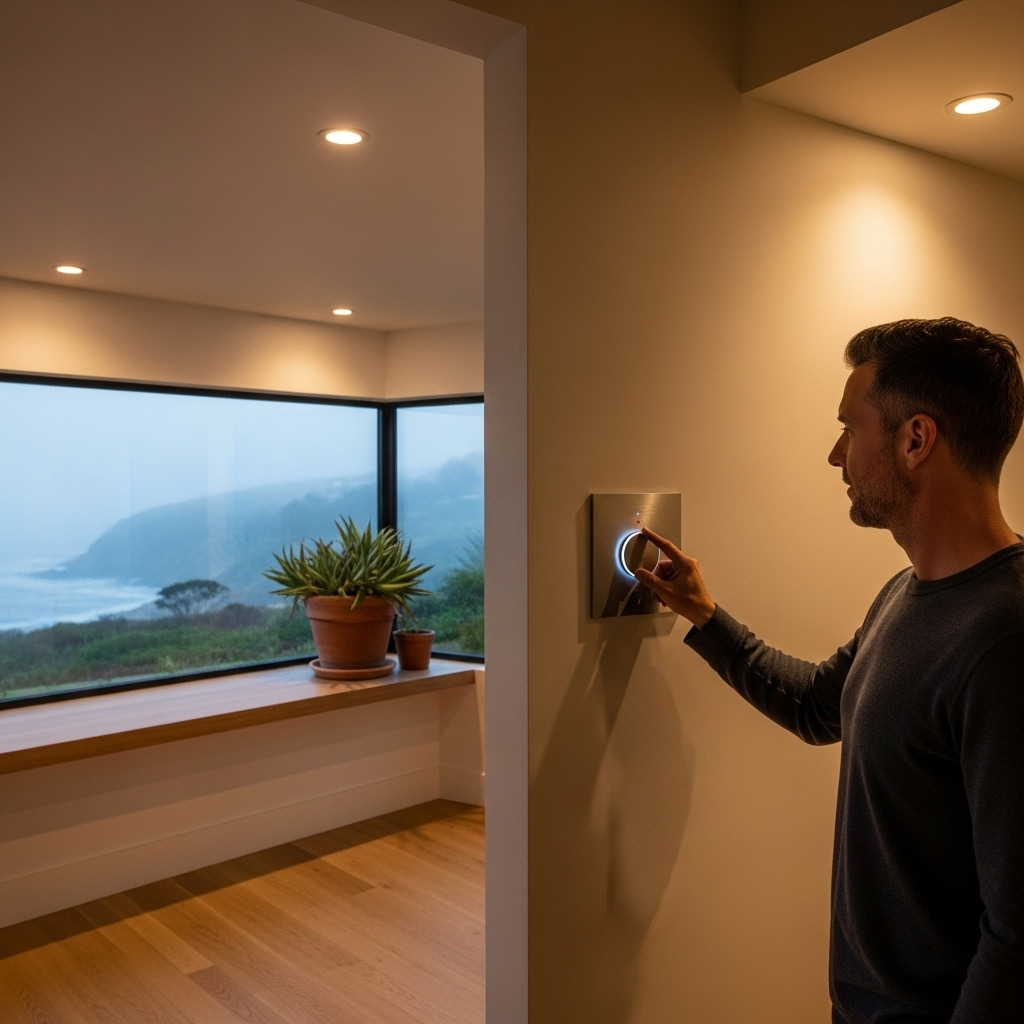
Dimmers: Enable mood and savings, particularly in living rooms, dining areas, and bedrooms. Pair dimmable bulbs with compatible dimmers for smooth performance.
Occupancy and vacancy sensors: In frequently used spaces like bathrooms, laundry rooms, and garages, sensors minimize waste by turning lights off when unoccupied. Vacancy sensors require manual on but shut off automatically, helpful where false-ons are a concern.
Daylight responsive controls: In naturally bright spaces, daylight sensors reduce output automatically, keeping light balanced without manual adjustments.
Smart scheduling: Timers and app-based controls align lighting with your routine and changing seasons, aiding both security and comfort.
Outdoor and environmental considerations
Exterior luminaires must be rated for damp or wet locations depending on exposure. Coastal environments benefit from corrosion-resistant finishes and sealed housings. For eaves and entries, select fixtures with glare control and appropriate cutoff to reduce light trespass. Motion-activated lights provide convenience and security while minimizing nighttime energy use. For pathways and decks, smaller, low-glare lights spaced intelligently can achieve better visibility than oversized, glaring fixtures.
Dark-sky mindful choices protect the night environment by limiting uplight and harsh glare. Shielded optics and warmer color temperatures outdoors can enhance comfort and reduce sky glow, while still delivering efficient, reliable performance.
Installation, safety, and code awareness
Many California homes have a mix of old and new fixtures. When upgrading, verify compatibility between bulbs, dimmers, and transformers. For recessed lighting, IC-rated and airtight housings help maintain insulation performance and indoor air quality. In garages and exterior spaces, ensure GFCI protection where required and use appropriately rated enclosures. For remodels, be mindful of required high-efficacy lighting and control measures such as vacancy sensors or automatic shutoff, which support both comfort and compliance.
Safe installation also means managing heat. Although LEDs run cooler, enclosed luminaires still need adequate ventilation. Follow manufacturer guidelines; do not exceed rated wattage equivalents and avoid mixing incompatible components that can reduce life or cause flicker.
Choosing quality: What makes one LED better than another
Two bulbs can appear similar on a shelf yet perform very differently over time. Indicators of quality include robust warranties, consistent color across batches, low flicker across the dimming range, and honest brightness claims. Look for packaging that identifies brightness in lumens, color temperature, color rendering, and whether the bulb is dimmable. Integrated LED fixtures should list expected lifetime in hours and provide clear details on driver performance and compatibility with common control types.
In decorative fixtures, LED filament styles vary widely; seek ones with uniform filaments that avoid hot spots and offer smooth dimming. For recessed and track fixtures, reflector design and lensing make a big difference in visual comfort and beam uniformity.
Mid-project buying checklist
When you are in the middle of an upgrade or considering a room-by-room refresh, revisit your criteria to avoid mismatches. Confirm color temperature per room, maintain high CRI where it matters, and double-check dimmer compatibility. Choose damp or wet ratings for bathrooms and exterior applications. Group purchases by project to improve color consistency. When you want to compare options and see how different fixtures can complement your design, reviewing curated examples of energy-efficient lights can help you finalize selections with confidence.
- Match lumen levels to tasks rather than guessing by watts.
- Keep a consistent color temperature within each visual zone.
- Use high CRI for kitchens, baths, and closets.
- Confirm dimmable components and compatible controls.
- Select ratings appropriate to damp, wet, or insulated contact areas.
- Plan for glare control with lenses, diffusers, and thoughtful aiming.
Sustainability and end-of-life
LEDs last significantly longer than incandescent or halogen lamps, reducing waste and replacement frequency. When they do reach end-of-life, handle responsibly. Do not mix LEDs with older fluorescent tubes or CFLs, which contain mercury. Keep paperwork or photos of model numbers, especially for integrated fixtures, so you can match replacements or components if maintenance is ever needed. Choosing quality reduces the frequency of replacements and ensures the light you enjoy today will feel the same years from now.
FAQs
Question: What color temperature should I use in a California kitchen? Answer: Neutral-white in the 3500K–4000K range provides clarity for cooking and cleaning while keeping materials like stone and wood looking natural. Use high CRI for accurate color.
Question: How many lumens do I need for a living room? Answer: Consider the room size and layers. Combine ambient lights, task lights for reading, and accent lights for art. Aim for comfortable, dimmable ambient levels and add targeted task lights instead of relying on a single bright source.
Question: Are all LEDs dimmable? Answer: No. Check packaging. Pair dimmable LEDs with compatible dimmers to avoid flicker or buzzing, and consider bulbs noted for low flicker.
Question: Will LEDs work in cold garages or exterior fixtures? Answer: Yes, quality LEDs start reliably in cold temperatures, and many are designed for damp or wet conditions when properly rated.
Question: What is CRI and why does it matter? Answer: CRI measures how accurately a light source reveals colors compared to natural light. A higher CRI (90+) is valuable for tasks like cooking, grooming, or evaluating fabrics and finishes.
Question: How can I reduce glare with bright LED fixtures? Answer: Choose fixtures with proper lensing or diffusers, select appropriate beam angles, and position lights to avoid shining directly into eyes. Dimming capability also helps fine-tune comfort.
Question: Are integrated LED fixtures better than screw-in bulbs? Answer: Integrated fixtures often deliver superior optics and slimmer profiles, but screw-in bulbs make replacement simple. Both can be excellent when sourced from quality manufacturers.
Question: Do I need special bulbs for bathrooms? Answer: Use damp-rated fixtures indoors where moisture is present, and pick high-CRI lamps with color temperature that flatters skin tones. For enclosed shower areas, look for wet-rated luminaires.
Question: Can smart controls really save energy? Answer: Yes. Scheduling, occupancy sensing, and daylight response reduce run time while giving you more control over ambience and convenience.
Question: What is the best way to approach a whole-home lighting upgrade? Answer: Start with a prioritized list of rooms and tasks, standardize your color temperatures by zone, and verify control compatibility. Test a few bulbs or fixtures in key spaces before buying in bulk.
Ready to brighten every room
You do not have to choose between comfort, style, and efficiency. With thoughtful selection and a few smart controls, you can enjoy better light and lower energy use every day. If you are ready to move from ideas to action, explore curated options for energy-efficient lights, compare features that matter most, and begin your upgrade with confidence. Start where you spend the most time, keep colors consistent, and build a home that looks great morning to night.